
The future of Italy’s energy security and transition — as well as innovation in electricity generation — also hinges on the project financing of initiatives such as the new combined-cycle units equipped with next-generation turbines at EP Produzione’s power plants in Tavazzano and Montanaso (LO) and Ostiglia (MN).
But what are the advantages of this strategy and its future perspectives? We asked Massimo Sgalletta, Director Finance and Back Office at EP Produzione, and Manfredi Sieni, Director A&F – Infrastructure & Power Financing Italy at UniCredit.
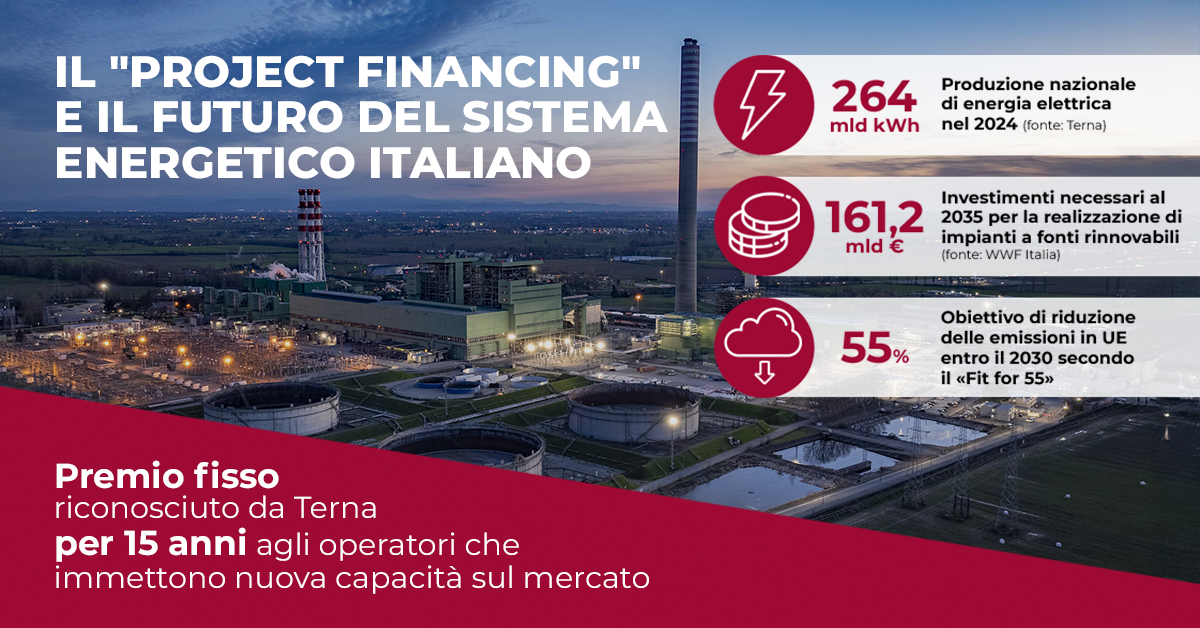
The year 2030 will mark one of the first significant deadlines set at the European level for the environmental transition: under the Fit for 55 plan, member states must reduce emissions by 55% compared to early-decade levels.
Now just five years away from that milestone, Italy and Europe’s energy transition has reached a pivotal phase. Productive sectors are being called upon to play their part — and the energy sector is undoubtedly among the most influential, as the choices made here will shape the path towards a sustainable future.
At the forefront of this journey are energy companies like EP Produzione, which have long been committed to modernising their plants and adopting more sustainable solutions. The construction of the new combined-cycle unit at Tavazzano and Montanaso, and the development of another at Ostiglia, are a testament to this commitment. These plants not only improve performance, but also enhance overall efficiency, making a vital contribution to national energy security and decarbonisation.

To finance these ambitious projects, as Massimo Sgalletta (Director Finance and Back Office at EP Produzione) tells us, the company has chosen to collaborate with UniCredit: “This partnership is just the latest step in a long-established relationship between us and UniCredit, which began in 2019 with an initial initiative involving two plants for electrical energy production from biomass”.
Manfredi Sieni, Director A&F – Infrastructure & Power Financing Italy at UniCredit, also highlights the importance of the collaboration between the two companies: “We can say that the commercial relationship between our companies started much earlier, since UniCredit has long supported the EPH holding company in the Czech Republic and other European countries. A well-established relationship that later extended in Italy with EP Produzione”.
As part of this collaboration, the tool of ‘project financing’ was adopted, and its features are particularly advantageous for energy companies that have to finance substantial investments without weighing on their shareholders, as the return on this investment will materialize only once the work is completed. Sgalletta explains that the ‘project financing’ has become one of the main levers to support the energy transition: “Today there is a strong focus on everything is ‘green’, but not all such projects are bankable: to attract the interest of the banking world and obtain fundings, the projects must also have characteristics that make them consistent with the goals currently required by the national and European energy system. In the specific case of Tavazzano and Montanaso, thanks to ‘project financing’, it was possible to access financial resources from the early construction phases, contrary to what happens with traditional financing methods, where financing is based on already existing cash flows”.
Manfredi Sieni presents us more closely this financial instrument: “In this case, an institution like UniCredit is not just a lender, but a real strategic partner: our function is to help to structure the projects so that they are sustainable and aligned with the goals of the transition. Energy sector has complex financial dynamics and requires in-depth knowledge to structure operations like these. For this reason, we worked with EP Produzione not only on the financial part, but also on the proper allocation of risks and on the strategic planning. It is essential that everything is built to ensure long-term financial stability”.
From this point of view, what are the aspects that make a project suitable for being financed through the ‘project financing’? Sieni replies: “Banks evaluate some key elements, starting with the actors involved — properties, constructor, maintainer and buyer of energy —, continuing with the risks and the evaluation of how is possible to manage them at best, to finish with the predictability of cash flows as the single source of the debt repayment. Specifically, in the case of the new combined-cycle unit’s energy activities, there is a peculiarity: thanks to the capacity market mechanism, companies benefit from a solid and reliable buyer of production capacity, which improves the bankability of the whole project”.
Sieni clarifies that the ‘project financing’ also represents a security for investors: “Terna’s role is fundamental in this context because, in the face of the new production capacity created and offered on the market (and provided that this capacity meets certain emission reduction standards), it guarantees operators a fixed premium for 15 years. This significantly reduces the project risks, making EP Produzione’s initiatives both financeable and profitable also for banks. Thanks to these structural elements, in fact, it is possible to implement projects with a balanced risk profile, transforming initiatives that may initially appear risky into solid investments with significant economic returns”.
“The introduction of next-generation combined-cycle turbines is a fundamental step for ensuring that the Italian energy system becomes not only more efficient, but also greener,” adds Sgalletta, who clarifies: “At Tavazzano and Montanaso, not only the power plant’s efficiency has improved, but also the specific CO2 emissions have been reduced, in line with the goals of decarbonization. Projects like these, which combine efficiency and sustainability, are particularly suitable for being financed through the ‘project financing’ than other more traditional investment methods”.
Finally, Sieni emphasizes that the growing attention to decarbonization goals and the need for new plants will make the use of innovative financial tool increasingly fundamental: “Even from the banking perspective, we are convinced that the ‘project financing’ can play a strategic role in support of large-scale infrastructure works, such as those we are now seeing in the energy and infrastructure sectors”.
Massimo Sgalletta confirms this perspective by looking ahead: “We are already evaluating possible future applications of a tool that by now we know very well. Looking at the decarbonization goals set for 2030, it will be increasingly necessary to finance new plants with private capital and instruments such as the ‘project financing’. It is now clear that this model will be the basis of many other energy innovation projects”.
In conclusion, the flexibility and investment appeal of ‘project financing’ make it a key enabler of Italy’s energy transition. It supports ambitious, capital-intensive initiatives with long timeframes — not just in energy, but across national infrastructure. In doing so, it embodies a broader vision of inclusive and sustainable growth, driven by innovation, ESG alignment, and public-private cooperation.