
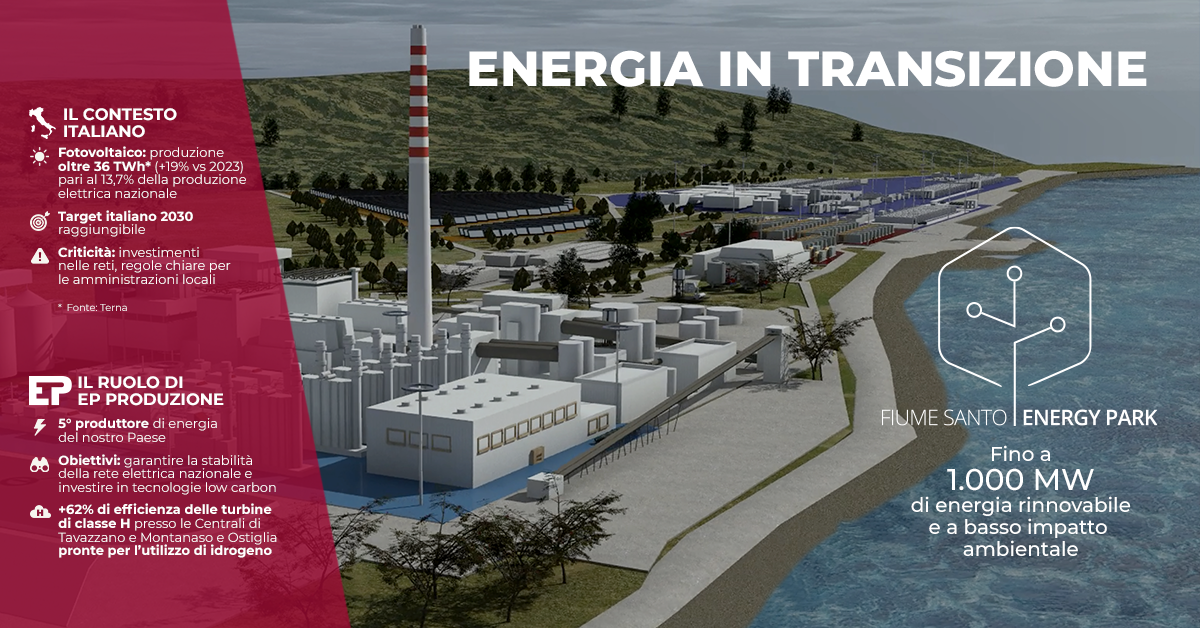
The energy transition is one of the major challenges of our time. At stake are environmental goals, industrial strategies, grid stability, and above all, the country’s energy future. In this context, EP Produzione – one of the main electricity producers in Italy – is moving along a double track: on one side, ensuring the reliability of energy supply, on the other, promoting a sustainable future through investments in new technologies.
To explore these issues, we spoke with Matteo Mazzarini, Head of HSE (Health, Safety and Environment) at EP Produzione, Arturo Lorenzoni, Associate Professor of Economics of Energy at the University of Padua, and Anna Mazzi, Associate Professor of Environmental and Safety Management Systems at the same university. Together, we explored the meaning of the energy transition in Italy, where EP Produzione’s power plants, in particular the new cutting-edge combined cycle unit started in 2024 at Tavazzano e Montanaso and the one under construction in Ostiglia, play a strategic role in leading the country towards a low-emission future.

As Mazzarini explains, EP Produzione embraces this role: “As a company, we are on the one hand the fifth largest national energy producer and, through our plants, we ensure the stability of the electric system. On the other hand, we want to confirm ourselves as technological innovators, with increasingly efficient plants and cutting-edge projects, such as Fiume Santo Energy Park, in Sardinia, able to integrate technological solutions, energies and skills in the service of a balanced transition. An ambitious transformation, which could represent a model also for other industrial sites”.
Arturo Lorenzoni immediately frames the context of our country: “In Italy, we have started the path of energy transition, but the road to making it effective is still uphill. There is a lack of a clear industrial strategy, capable of enhancing the enormous potential of renewables, by integrating them into an energy system that truly works”.
Lorenzoni highlights the gap between ambition and governance pointing out how much is currently left to companies, rather than to regulators or legislators. “Let’s think about the state of photovoltaic. At the beginning of 2025, we had 340 gigawatts of grid connection requests, but if we’re lucky, we will realize maybe a third. The rest is just entropy: congestion for Terna, stress for local administrations, high risks of inefficiency. In this situation, the same companies that want to invest find themselves in difficulty, because they are not facing a clear scenario”.
Mazzarini adds: “At a time like this, we believe that our role is to ensure the system stability by investing in the efficiency of the plants, using the gas as vector for transition. In this regard, we are renewing our power plants through two major investments, with the installation of class H turbines at the power plants of Tavazzano e Montanaso and of Ostiglia, in Lombardy, capable of achieving over 60% efficiency and therefore of producing more energy with fewer emissions”.
Given the current context, EP Produzione’s approach is both strategic and pragmatic: to continue being reliable while pursuing a clear and measurable transition path. Lorenzoni recognizes the value of this position, emphasizing the importance of system-wide cooperation: “There is no doubt, gas is still indispensable today, but we must distinguish between civil and industrial uses. For the electricity system, it can still be a useful vector, also thanks to power-to-gas technologies, but it is crucial that this function be part of a broader vision, where each energy technology is used for the application in which it proves most efficient, progressively increasing the renewable component”.
Mazzarini continues: “Fiume Santo Energy Park project, in Sardinia, is a very interesting case from the perspective of energy transition, and our goal, beyond the decarbonization, is to generate value also for the territory”.
Anna Mazzi gives value to the project, recognizing its complexity: “It is a good example of an integrated system. Diversifying sources also means increasing the resilience: if a resource is scarce or is less, the entire system still holds. And there is a positive social impact: it creates jobs and activates new skills”.

“I think we fully agree on that”, replies Mazzarini. “Our approach starts from a contextual analysis: Fiume Santo Energy Park aims to create an integrated and balanced energy mix, that will contribute to achieve an energy transition based on plants and technologies appropriate for the times”.
Lorenzoni also agrees with the approach: “There is no such thing as universally ‘good’ energy source. Each technology makes sense only if it is used consistently with its strengths. Geothermal, for example, exploits the heat already available underground and it is perfect for continuous applications, such as the home heating. Photovoltaic, instead, can be used to directly power electric consumption, maybe within an energy community. In the future, hydrogen will certainly be a vector, but today we are witnessing some strange drifts: why use photovoltaics to produce green hydrogen for hydrogen-powered buses, when we could simply use the same photovoltaics to charge electric bus batteries directly?”.
“This insight clearly captures the situation not only in Italy, in which we operate as a company”, Mazzarini adds. “That’s why we have invested in turbines that can already use hydrogen in blend with natural gas. It’s a technology that can play an important role in the future energy mix”.
Lorenzoni advises caution: “I also believe that in the future the possibility of using increasing shares of hydrogen as fuel will be decisive. But as of today, it is not a panacea, because it is expensive and competitive only thanks to the subsidies. For many applications, such as light transports, direct electric solutions have far better efficiency. In electricity generation, if a real green hydrogen supply chain were created, it would instead be an interesting possibility”.
Mazzi closes the circle: “I believe this brings us back to the initial theme: every choice must be guided by systemic analysis. We need to assess costs, benefits, risks and long-term impacts. And a systemic approach cannot be separated from an integrated vision. Italy has the skills to lead this transition, but in order to do that it must ts strengths. Companies, institutions, universities: all must work together. Sustainability is not a luxury, but a necessity”.
“You know, Matteo,” Lorenzoni adds, “I remember when turbines had 40% efficiency and the State incentivized those who reached 50%. Achieving 62% efficiency shows that today the turbines have reached an incredible technological level”.
At this point, the discussion opens to more transversal themes, since the transition is not only a matter of technological renewal and energy mix, but also of planning and foreseeing future developments of today’s choices. Anna Mazzi draws attention to the life cycle calculation of technologies: “A long-term vision is equally fundamental. It’s not enough that a technology is ‘green’ in its use phase – which corresponds to today – but even the construction of the plants must be ‘sustainable’. For this reason, it is necessary to adopt a broader perspective and include all the activities required to build the technology and manage it over time until its decommissioning: this is the ‘from cradle to grave’ approach. For example, if to build a panel rare earths that are extracted unsustainably are needed, we are not achieving a real sustainable transition, but rather we risk shifting the dependence from some non-renewable sources (oil and gas) to others (critical raw materials)”.
A systemic approach is therefore essential, even to assess the geopolitical dependencies related to the raw materials.
“The European Union is rightly aiming at a strategic plan to reduce the dependence on critical raw materials, which are essential for the energy transition but are mostly supplied by non-EU countries, often characterized by political instability. Therefore, the issue of transition is not only environmental, but also economic and of security.”
As highlighted by the discussion with our guests, the success of the energy and environmental transition challenge requires a clear strategy and long-term vision, capable to balance technological innovation, respect for the environment and collaboration among all stakeholders involved. Looking ahead to 2030 and 2050, EP Produzione continues to operate as protagonist in the Italian energy landscape and is ready to do its part for the national and international goals of sustainability and decarbonization to be achieved.