
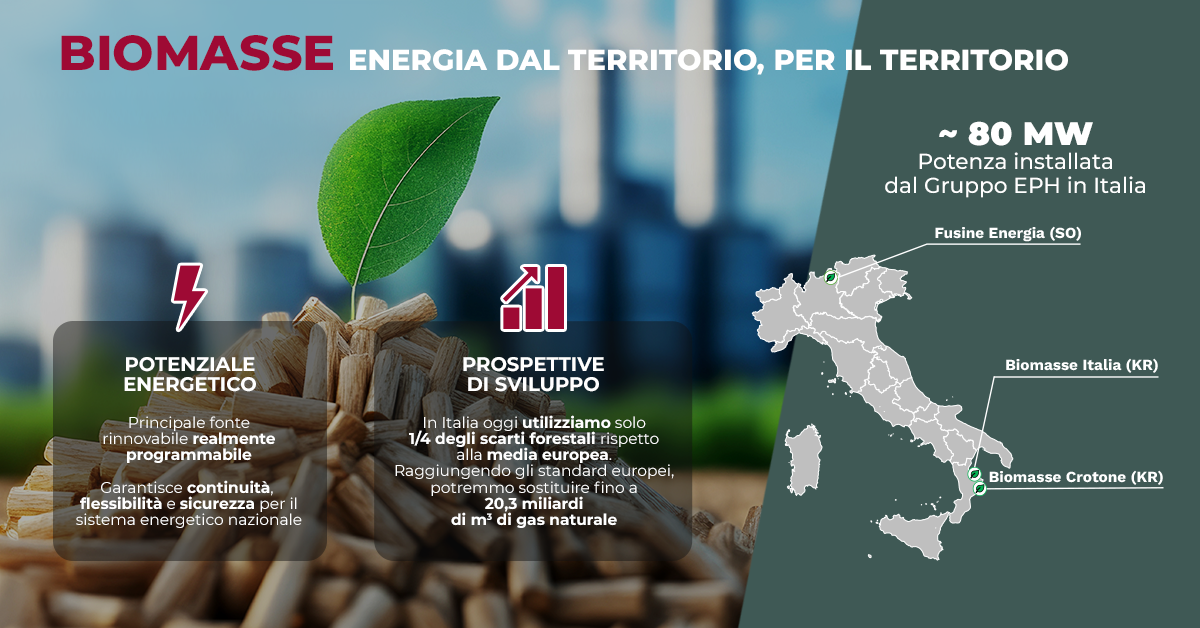
Solid biomass represents a strategic key for Italy’s energy transition, but its potential has not yet been fully exploited.
Paolo Appeddu, CEO of Biomasse Italia and General Manager of Fiume Santo S.p.A., together with Hon. Luca Squeri, Head of Energy Policy for Forza Italia, and Prof. Stefano Grigolato, Lecturer at the Department of Land, Environment, Agriculture and Forestry of the University of Padua, discussed the future of these resources within Italy’s energy mix.
***
When we talk about biomass, we refer to organic materials of plant or animal origin that can be used to produce energy — in the form of heat, electricity, or biofuels. Although biomass involves combustion, the limited amount of CO₂ released during the process is offset by that absorbed by plants during their life cycle.
But biomass is more than that: it is a natural, widespread resource, capable of regenerating territories affected by disasters or environmental crises, while revitalizing rural and local economies. From this perspective, biomass plants contribute to creating and sustaining local micro supply chain: wood suppliers are often small enterprises or family-run businesses operating under authorized forest management plans. Their work helps make forest safer, more accessible and more livable.

“Biomass is the main renewable source that is truly programmable, capable of ensuring production continuity, flexibility, stability, and security for the national energy system — something that solar and wind power cannot guarantee in the same way”, says Paolo Appeddu. “At a time when all countries are engaged for a greater share of renewables in their energy mix, biomass can prove to be an excellent solution”.
Currently, the EPH Group currently manages about 80 MW of installed capacity in Italy, distributed across three plants. “Two of them are located in Calabria, in Crotone and Strongoli: they are large plants located near ports”, Appeddu explains. “Their development is linked to the reconversion or completing of pre-existing industrial chains. The third plant of about 7 MW is located, however, in Valtellina, precisely in Fusine, in the province of Sondrio, and is smaller in size”.
“Today, biomass can be used in a modular, continuous, and sustainable way. Above all, it reduces our country’s energy dependence — in a challenging historical moment that, since the war in Ukraine, has taught us how essential it is to rely on local and sustainable energy sources”, adds Hon. Squeri. “Biomass is not the only answer, but it must be properly valued. From my point of view, there are two keys area to work on in the coming months and years: first, the European taxonomy, which does not clearly identify biomass and creates regulatory uncertainty at the EU level: we need a clear national position. Second, the lack of targeted incentives for those investing in this technology. It’s not only a legislative issue, but also one of effective, long-term fiscal policies that enable real planning for the entire supply chain”.
Prof. Grigolato also weighs in: “It is important to distinguish plants that use genuine biomass from those processing other materials, such as Solid Recovered Fuel (SRF) or municipal waste. The biomass supply chain must also be protected from a reputational standpoint, recognizing and supporting those who operate correctly within it. From this perspective, Biomasse Italia is a leading player at the national level”.
Biomass represents a tangible model of integration between environmental sustainability, energy security, and community well-being, even in the face of unpredictable events.
“For instance, Biomasse Italia is currently working in the province of Brindisi to recover wood from olive trees destroyed by Xylella. It is an initiative with strong environmental value, transforms a phytosanitary emergency into an energy resource — but also with social value, creating jobs and reactivating the local supply chain”, explains Appeddu.
The Xylella epidemic devastated olive growing in Apulia, but the recovery of infected wood has helped farmers reduce uprooting costs. “This material is treated using a fumigation process abord ships, developed together with phytosanitary institutes in Apulia and Calabria, which ensures sterilization before arrival in Crotone”, underlines Paolo Appeddu.
However, the wood affected by Xylella has a very short utilization window: “It must be recovered quickly or it deteriorates”, explains Prof. Grigolato. “In other contexts, such as the phytosanitary emergencies in forest environments – for example the Ips typographus epidemic in the central and eastern Alps – the rapid mapping of affected areas and the creation of suitable logistics infrastructure have proven to be a replicable model even beyond the forestry sector, as in the case of Xylella. It’s a true example of circular economy, achieved through more efficient processing and logistics. However, it is not only a technical issue: a proper regulatory framework is also necessary. Today, in fact, some wood-based residues are classified as waste, making many initiatives complex or even unfeasible, such as the use of urban prunings or the recovery of biomass from land management in non-forested areas. To promote a broader circular economy, all untreated woody biomass residues should be enhanced, not penalized”, adds Grigolato.
He recalls another emblematic case: the Vaia storm of 2018, which felled millions of trees across Alpine forests in central and northeastern Italy. “It was a dramatic event with major environmental, economic, and social impact. The local response was immediate and strong, showing remarkable resilience, but also revealing some limits. Much of the recovered material involved foreign companies and was exported, reducing local economic benefits. If greater local wood-processing capacity had been available, more forest biomass residues could have been valorized nationally, leading to stronger economic recovery and more effective territorial resource management.”
As mentioned, beyond their environmental value, biomass is also a real driver for local development. Hon. Squeri makes it clear: “Each plant generates significant economic activity: transporters, collectors, maintenance workers, chipping plants. Dozens of small local companies are involved. And then there’s the territorial stewardship aspect: if the forest is managed, the risk of instability and fires is reduced”.
“Agriculture can also benefit from this supply chain”, adds Appeddu. “Many orchards, once they reach the end of their productive cycle, must be uprooted. The resulting wood can be supplied to plants such as those managed by Biomasse Italia, generating additional income for farmers and encouraging reinvestment. The same goes for prunings, which are an important secondary resource”.
Appeddu continues: “We are also working on a project involving maritime pines cut down for urban safety or to contain pests that affect homogeneous, aging pine forests. Such preventive measures would not be possible without operators being able to valorize the wood that would otherwise become a disposal problem. Moreover, even the by-products generated by our renewable energy generation process, such as ashes, can be reintroduced and reused in appropriate production cycles. It’s a 100% circular vision”.
When it comes to sustainability, the biomass value chain also supporto active forest management — particularly relevant since over 70% of Italian forests are not regularly monitored.
Prof. Grigolato resumes: “At the European level, important policies are being implemented: in the new LULUCF Regulation (Land Use, Land-Use Change and Forestry) and the RED III Directive (Renewable Energy Directive III), recognize the value of sustainable forest management, also linked to the concept of carbon farming — an agricultural approach that reduces greenhouse gas emissions and increases carbon sequestration in soil and vegetation. This is crucial opportunity”.
Hon. Squeri highlights other challenges: “In critical areas such as the Po Valley, emissions remain an issue. Italy still does too little: our use of forest residues is about one-quarter of the European average. If we could match it, we could replace up to 20 billion cubic meters of natural gas. It’s an impressive figure that shows the scale of the opportunity”.
Hon. Squeri also highlights a timing advantage: “An alternative such as nuclear energy may take a decade to deliver tangible results, while bioenergy can already provide fast, concrete contributions towards achieving our 2030 targets”.
Paolo Appeddu introduces the need of a cultural shift: “There is a lot of misinformation about biomass. Many people see forests as sacred, untouched spaces to be admired but not managed. The reality is quite different: in densely populated areas like those in Italy, unmanaged forests can become environmental and safety hazards. Biomasse Italia plants operate using residues, materials that would otherwise rot in the woods or burn, releasing CO₂ anyway”.
“I agree”, concludes Prof. Grigolato. “A managed forest is safer, more productive and more resilient. If we can help people to perceive biomass as part of a circular and sustainable economy, we could make it a powerful lever for the ecological transition”.
“For our part”, adds Hon. Squeri, “we will continue promoting biomass at the institutional level. Recently, it was excluded from the €1.2 billion National Recovery and Resilience Plan (PNRR) fund for improving public buildings – a decision I find inexplicable, considering that biomass is an effective, ready-to-use renewable source that leverages local sources. We’ll keep pushing for a dedicated incentive plan and an educational pathway.”
“We are already working on that”, concludes Appeddu. “Our company has started opening its plants to students, to raise awareness about sustainable forest management. We believe this is a great opportunity not only to make biomass better known, but also to show how Italy’s environmental, energy, and industrial systems are closely interconnected and require a systemic action”.
Because that is what biomass truly is: a systemic key for driving the energy transition, promoting sustainable forest management, and regenerating local territories.
An energy that, born from the territory, remains within it, contributing to local development and community well-being.